Musée d'Orsay

I walked to the Musée d’Orsay this morning. It took the best part of an hour, and I waited in a queue for another hour to get in. It has finally turned cold, and I was well and truly ready for a bit of the sublime by the time I got to see some art.

There is a lot of Salon stuff on the ground floor, which holds only so much of my interest. It’s all very noble and symbolic, but the horrors of the 20th Century make half-naked military heroes seem like bad satire.

Let’s be blunt here. It’s a museum devoted to (mostly French) art from about 1848 until about 1914. You don’t have to be a journalist with a beret and a glass of Chablis to know what that means. I came to see the Impressionists and their ilk. Okay?

It’s a truly beautiful building inside, although getting to Level 5 where said Impressionists, Neo-impressionists and other members of the great new art meant more stairs than I cared to count. There are lots of escalators, but they were all going down. I felt like I was in an Escher drawing.

It was worth every small obstacle, of course. We could argue for hours on the merits of the individual painters, and even debate their political stances given they were sandwiched between two great revolutions. There’s no point. Compressed into a gallery no bigger than a couple of dance floors, the works on show are just too damned lovely to demean with any sort of polemic. Look, absorb, smile, commune, celebrate and perhaps weep. The highest achievements of humanity pumped straight into your senses.

There were many highlights. Here’s one - Berthe Morisot’s Dans les blés. That’s the very same Berthe that Manet painted in some of his best portraits, by the way.


Rue Mazarine

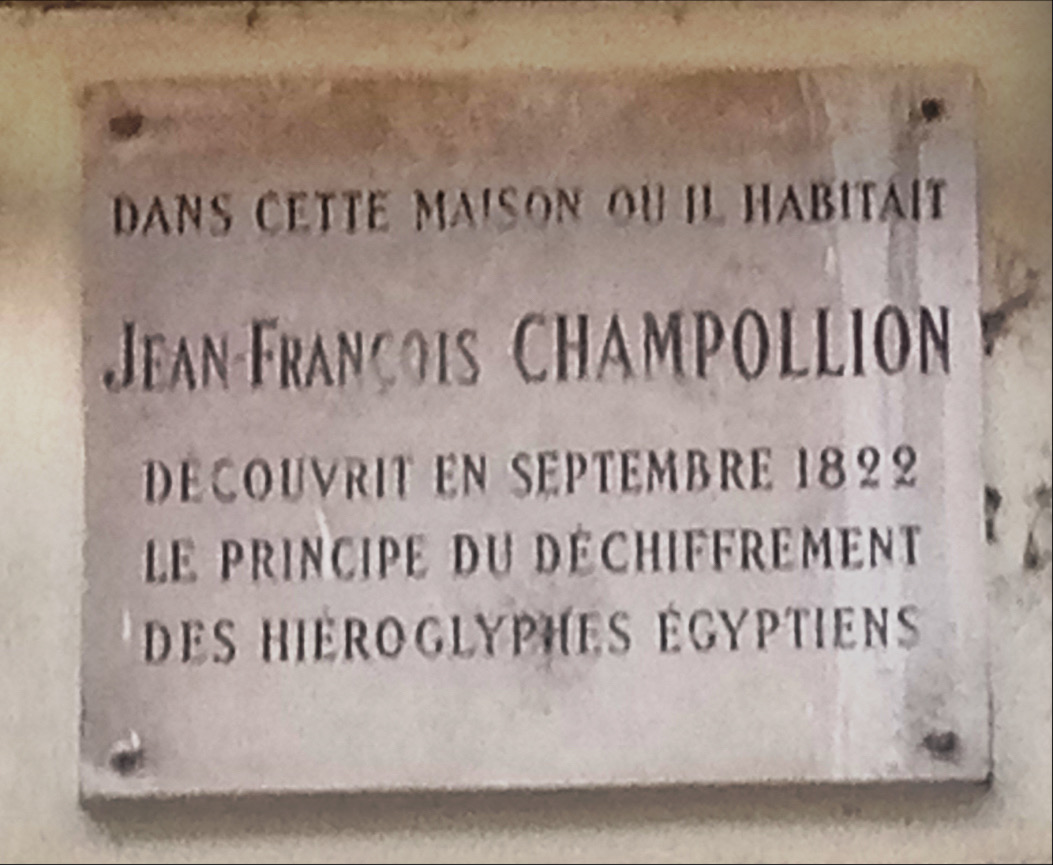
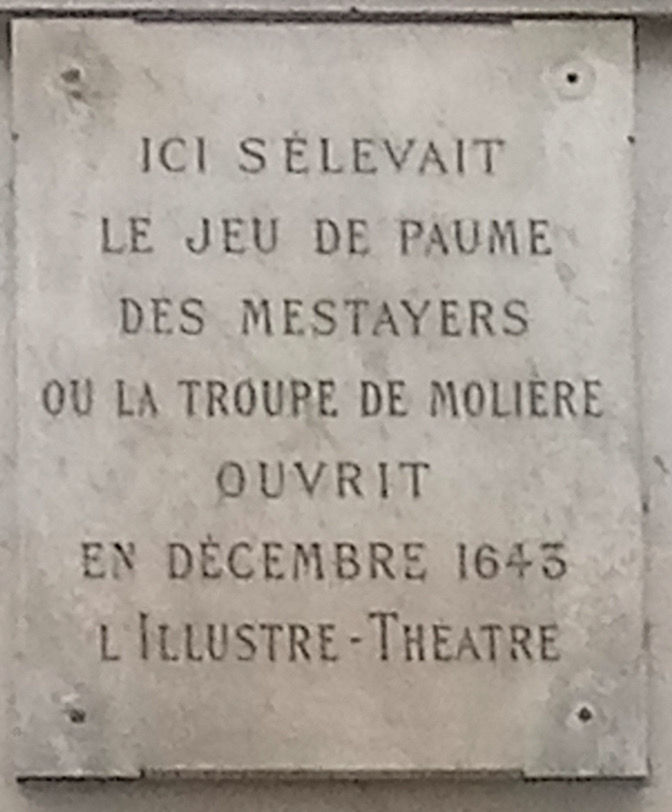
One of the many pleasures of walking in Paris is stumbling upon obscure historical plaques on the sides of otherwise nondescript buildings. In Rue Mazarine, which is near the Seine and virtually in the centre of the city, I came across three within a hundred metres of each other that got my geek-tourist juices flowing:


Theatrical types might hone in on Moliere, but it was the reference to Champollion that got me a bit excited. He was the first to decipher Egyptian hieroglyphics and unravel the “mystery” of the Rosetta Stone. There are a bunch of documentaries about him, including this little piece narrated by Carl Sagan:


This is an bloody amazing city to wander around.

Jardin des Plantes


I’d planned a visit to Musée d’Orsay today, but it seems lots of places are closed on Mondays, most museums included. So I took a 10 minute walk to the Jardin des Plantes.

The Paris Botanical Gardens date back nearly 400 years and cover 19 hectares of various styles of garden. There are long stretches of neat garden beds interspersed with the buildings of the Museum of Natural History. There is a zoo, which I avoided. There are some lovely less frequented areas for specimens of particular climate types.

I spent several hours in the Alpine Garden. It’s a surprisingly lush, happily wild enough affair that would make the heart of my friend Marie-Louise sing.

Can the term “exquisite” apply to a vast garden? I guess it depends on the point of observation and the scale of observance. These are crafted gardens, but nothing like the ordered regiments of Palais Royal or the Tuileries. This garden is tended (by many, it seems) but not at all restrained by borders and edges. Plants mingle and climb each other, and tumble down walls and across paths. It was busy today, but not crowded, with bird song and rustling leaves rising above the rumble of traffic.

The numbers of gardeners at work surprised me. Surely the sign of a civilised society when public gardens have such resources applied.

Gallery

Liberté, égalité, fraternité

Came across this modest elementary school on my walk around the neighbourhood today.


A modest school indeed, but a bunch of dried flowers beneath a plaque caught my eye.


I could read it well enough, but I’ve resorted to Google translate for more comprehensible prose:

IN THE MEMORY OF CHILDREN, STUDENTS OF THIS SCHOOL, DEPRIVED FROM 1942 TO 1944 BECAUSE THEY WERE BORN, THE INNOCENT VICTIMS OF BARBARIA NAZIE WITH THE ACTIVE COMPLICITY OF THE GOVERNMENT OF VICHY, THEY WERE EXTERMINATED IN THE CAMPS OF DEATH.  
 NEVER FORGET THEM 
January 11, 2003

Basilique du Sacré-Cœur

After my visit to Musée de Montmartre, my heart rate was low enough to make an attempt on the summit, which is crowned by Basilique du Sacré-Cœur, a not particularly splendid church built in the 19th Century. It was, apparently, against the wishes of many of the more radical locals, who thought it against the spirit of the place. 

As it turns out, I’m with the radical locals. It’s noted for its panoramic (fuck it, when is a view from the top of a hill not panoramic?) view of Paris. Now, I can’t actually attest to the quality of the view, as it was teeming with tour groups all madly snapping photos over the heads of other tour groups. I’m pretty sure most photos turned out like mine:


The car park at the front of the Basilique du Sacré-Cœur features in many of Claude Lelouche’s films. Claude is my all-time favourite film director, and he used the location in his 1976 nouveau-bogan classic, C'était un rendez-vous. The film is a mere 8 minutes of a single shot from the front of a car being driven at break-neck speed through Paris. To be honest, it’s probably not Claude’s finest film, but why take my word for it? Make your own mind up. Here, Mesdames et Messieurs, is the full, unexpurgated C'état un rendez-vous.


Frankly, Lucy Jordan, you did yourself a favour not driving through Paris in a sports car with the warm wind in your hair.

An afternoon in Montmarte

I spent my Saturday afternoon visiting the famous hill of the artists and Bohemians. Actually, explaining Montmartre in that last sentence is probably redundant. If any of my friends aren’t even vaguely familiar with Montmartre, well, consider yourself unfriended.

I caught the Metro to Abbesses, which is below the top of the hill. The station is the deepest in Paris, and the escalators weren’t working, so a clamber up the spiral stairs made me wonder how so many people can smoke in Paris. Montmartre, as it turned out, is awash in cigarette butts, so I assume they all have cars.


The area around Abbesses is nice enough, but not greatly different than any of the restaurant and cafe areas found in the centre of Paris. I headed (uphill) to the Musée de Montmartre, for a look at a collection of mostly lesser known drawings, posters and paintings dating to the Belle Époque.  The Musée occupies the oldest house in Montmartre, and still boasts a small vineyard, albeit I suspect it’s there just to add to the vibe.

I had a most civilised coffee and cake in the garden cafe, and the weather had turned positively balmy. I’d left my apartment rugged up for an Antarctic expedition, so I performed a discreet striptease between spoonfuls of cheesecake. It’s a worry that Paris is still quite warm. I have a shipping container’s worth of thermal underwear in my suitcase, and it’s yet to have the pleasure of my nether regions. I can see myself dressing stray dogs in the Jardin des Tuileries. Today was rainy, but no colder.

The highlight of the Musée de Montmartre for me was the collection of materials related to the Chat Noir cabaret(s). I’d only vaguely heard of it, but it seems it was a wild old time at its multiple iterations. They had posters, drawings, letters and this lively oil painting which once decorated its walls:


Image Wikimedia
No mention, strangely, of Le Moulin de la Gallette and only a little on the Moulin Rouge. 

It’s not exactly a grand gallery, but the peace and civility were welcome. The best Paris might yet be revealed by its small treasures.


In praise of deduction

So here’s a vaulted ceiling I came across in the Louvre. It’s in the lower levels, where the antiquities collection is displayed. I don’t remember which antiquities - I think this bit might have been the Byzantine stuff, give or take a few thousand years.

Keen students of vaultology will notice the arches are perfectly aligned. This makes the score one all on the wandering ceiling phenomena I’m dedicating the rest of my life to.

From my observations so far, I’ve deduced that laser alignment systems were invented between 1270 and 1547.

Life as a dilettante

Image Wikimedia
Saw this in the Louvre today, in a little recess tacked on to the French collection. I did a double-take, as I thought it was a Manet, and belonged elsewhere. Shows my ignorance. It’s actually Goya’s Countess del Carpio from about 1794. Check out Manet’s portraits of Bertha Morisot 80 years later. I think I have a case - I’m writing up the PhD application in another window. Still means it was out of place, but it was a highlight of  a rather strained day fighting the crowds in the Louvre.

They opened a big exhibition this week on Leonardo, and the people have flocked. I wish they had flocked off, as I didn’t get the cerebral experience I was hoping for. Still, I did get to see the big Davids, including Napoleon doing a Trump at his coronation. They’re worth looking at, even if it’s just for the technical mastery. I lasted several hours, but the noise got to me. I wasn’t expecting silence, but the din was silly. I took a stroll down the Italian collection and it was more like Juventus vs. A.C. Milan, but with a worse view and no goals.

I know Goya did some very dark stuff, but the light touch in this piece has me interested. I think I need to get me to Madrid.

Sainte-Chapelle and the Conciergerie

This is when you know you’re not in Kansas anymore. The experience of entering Sainte-Chapelle is visceral. There’s nothing you can do but offer a helpless gasp. Or swear. Actually, I’ll come clean. I swore. Too loudly, but it was a gasp in spirit.

Image: Pixabay

Dating to the 13th Century, it was built to house relics from the Crusades. In the BBC series Art of France, Andrew Graham-Dixon called the Sainte-Chapelle, “...the most sublime expression of the Gothic spirit...  where architecture abolishes itself ... you experience it in terms of light and colour... a gigantic light box.” Andrew can go on a bit (he goes off like a two bob watch in Episode 3 when he gets to Duchamp’s bottle rack) but he got this very right.

Adjacent is the Conciergerie, another part of what was the royal palace for several hundred years. This building became a prison, and garnered infamy for housing many of those destined for the guillotine during The Terror that was the last year or so of the French Revolution. Most notably, Marie Antoinette, the Princess Di of her day, spent her last couple of months here. It so happens there is an exhibition running on all things Madame Veto. It focussed on her celebrity, so my only takeaway was the fact that Mattel produced a Marie Antoinette Barbie doll in 2003. Insert another helpless gasp here minus the visceral.

Surrounding the exhibition was the permanent display of matters revolutionary, and this served to illustrate that Paris probably still hasn’t got over what happened. There’s nothing like 40,000 executions to put a dampener on égalité and fraternité. What happens to liberté goes without saying.

Of much more interest than a celebrity princess and slightly over-enthusiastic French revolutionaries was the ceiling. I don’t think you can go past a good vaulted ceiling, and the Conciergerie has a cracker. It’s a huge space, relatively low, and it’s decidedly liquid and sensual in appearance. See for yourself:

There was one thing that stood out to me, and I’m afraid it was a bit disturbing .

Look closely. The points of each arched rib are out of alignment. It’s as if the vaults “wander” down and across the building.

The implications are worse than you might think. I’m going to have to spend the rest of my trip checking the alignment of vaulted ceilings.

I might need to make a spreadsheet.


Cake decorating


They’re very good at the grand statement are the Parisians. Especially when it comes to architecture. Every second building is a very large scale model of the ice cream cake you had at your eight birthday, only with more swirly bits.
Got a window? Well, that will need some carved scrolls and some wrought iron. Hmm. Needs more cherubim.
Still not right.
Jean, I want to place a bulk order for gilt. Without a ‘u’.

Where did I go to, my lovely?

I took a rain check on the Rolling Stones records.


Stedelijk

It’s a museum of modern art. It seems to specialise in “one of everything.” Klein, Rothko, Pollock, Picasso, Mondrian, Warhol... It’s a kind of chronological survey. Not always the best stuff, but very easy to digest.

The building is fun, too.


A feast

I made it to Paris tonight. A tiny apartment, but very liveable.
I celebrated getting here by finding an open supermarket, and preparing my own small feast.
À votre santé.


Walking the Jordaan


The Jordaan district was chilly and cold
Chilled my body but not my soul.


Furniture


The Rijksmuseum has an extensive collection. 17th and 18th Century high-art furniture is mostly hideous, albeit, in this case, astonishingly well crafted.

There are some more restrained gems, of course. These cabinets took my fancy:


Rijksmuseum superstars

It’s quite the place. It has its superstars. Vermeer is one.
Vermeer fans

Amsterdam hotel

I have a room in Amsterdam. It’s not big.
On the wall there’s an old inscription:
“Vincent was here.”

A room