Normal service will be resumed

I’ve entered into some weird cross-dimensional symbiosis with Vincent Van Gogh. Last night I fell out of bed and my ear caught on the corner of the bedside table. The top part of cartlidge was torn. There was a lot of blood. Same ear as Vincent too.

It’s mostly stopped bleeding now, but I was freaking people out on the bus today. Blood coming from one ear...

I’m feeling like I need to paint sunflowers.

Image public domain Wikimedia

To Amsterdam - Part the Second

Just before a tunnel that leads into Rotterdam, the high speed Thalys train became a no speed train.

The announcements got progressively worse. “Ladies and Gentlemen, we have a red signal, and we’re just waiting for it to change. We’ll be at Rotterdam Centraal very soon.”

“Ladies and Gentlemen, we have a red signal and we don’t know why. We’ll let you know when we know more.”

”Ladies and Gentlemen, there is a problem in the tunnel ahead, and we’re awaiting more information.”

“Ladies and Gentlemen, there is water in the tunnel. The Thalys train will not proceed until it is safe. This may take some hours. Those passengers intending to get off at Rotterdam Centraal should exit the train and walk to the Metro station.”

“Ladies and Gentlemen, we don’t know when we will proceed. Passengers wishing to get to Rotterdam or Amsterdam may wish to get off the train and walk to the Metro station. Take the Metro to Rotterdam Centraal, then seek instructions on how to get to Amsterdam.”

The by now quite drunk Canadian couple across the aisle were decisive. They chose to stay on the train and drink it out.

I too was decisive. I had a 6pm check-in deadline in Amsterdam. I was going for the Metro option. The Metro in The Netherlands, by the way, usually means trams. The place is two centimetres above sea level, so underground subways are mostly out of the question.

The Thalys conductor was also decisive. He was outside the train having a cigarette. I asked him how exactly one got to the Metro. He pointed towards a gaggle of suitcase-wielding decisive people in the distance. “Follow them,” he said between smoke-rings.

I stumbled down the embankment at the side of the train towards a pedestrian bridge. By the time I’d got to the steps, there was nobody in sight. Should I go back to the train? Not this cookie who used to be a Boy Scout. I had a plan.

I’m sure you’re thinking I climbed a tree or lit a campfire. Actually, I downloaded the Google map for Rotterdam, and used the CityMapper app to guide me through eerily quiet housing estates to the tram stop. There were a few people there from the train who seemed to know what they were doing, so I decisively (but discreetly) followed them.

Seven stops later, I strode dragged my suitcase into Rotterdam Centraal. I spotted the last remaining passenger from the train at the end of an escalator, but then I lost them. I was on my own again. After some time frantically crisscrossing the vast station, I found the ticketing office. I knew they’d want to help a stranded passenger. I went straight for the counter.

I was told to take a number and wait.

I took a number, but it was for the wrong type of train. Finally, some twenty minutes later, I explained my situation to a mildly helpful chap at the Thalys counter. I was to go to Platform 11. I could use my Thalys ticket there to get to Amsterdam.

Platform 11 was mostly deserted, so I walked down the platform to get a long overdue coffee. When I walked back, there was a small crowd of vaguely familiar individuals with suitcases. Within minutes, the familiar red of a Thalys train appeared and eased to a stop. After a small weep, I kissed the nearest conductor. It was two hours since I’d made my own personal version of Von Ryan’s Express, but I’d made it. This was epic stuff. I could sell the film rights. I chose the same carriage number as was on my original ticket, and crawled down the aisle, pushing my suitcase before me.

Two very drunken Canadians greeted me. “Hey, Aussie, you’re back...”

Image:© urbanrail.net but I don’t care, because they owe me. I’m using their map.

To Amsterdam - Part the First

My first (of many, I’m sure) change of plans. Rather than head south from Paris, I’m heading back to Amsterdam for a week or so. I had three days there before Paris and loved it. I think there may be much more to discover. After Amsterdam, I’m not sure. Berlin, perhaps.

I’m writing this on the Thalys, a high speed train that travels between Paris and the Low Countries. It takes about three hours to get to Amsterdam Centraal, and it’s a smooth, comfortable ride. We’re going to do a quick invasion of Belgium along the way.

I’m sitting next to a French-speaking woman who seems quite miffed that anyone would have the impertinence to book the seat next to her. She makes an entirely theatrical show of moving the arsenal of baggery off my seat. After a long, loud phone conversation (which is how I know she’s a French speaker) she pulls out her e-smoker thingy and proceeds to take long, deep gurgling draws that sound something akin to the guttural racket a cat makes just before it lets loose with last night’s Whiskas behind the couch.

Minutes later
Vapowoman has now decided that the first 150mm of my seat adjacent to hers is, in fact, her seat. She’s placed a stiff, rustly plastic bag up against my leg. I, of course, am a paragon of cool, and choose to ignore it. I’m wondering if I should casually put my hand into the bag and crush the contents.

More minutes later
We’re passing through some fine French countryside and I’m looking past her laptop and out the window. She is furiously typing emails (some people provide emphasis to what they write by hitting the keys harder) and mistakes my gaze to mean I’m reading her emails. Now, truth be told, if they were in English, I probably would read them, purely for my own edification. Unfortunately, she’s writing in French. I would like to get her email address though, so I can send her links to websites that show rotting lungs caused by vaping. Nothing like the sanctimony of an ex-smoker. Meanwhile she methodically angles her laptop screen away from me.

It’s one of the shortcomings of not having local language fluency - I can’t make acerbic, coded comments on her actions, so I’m left to just sigh loudly. Hey, she wants to be melodramatic? Two can play at that game. Sadly, she’s too busy munching on a too-healthy-to-be-tasty salad in between cat-fart gurgles to notice my superb pantomime.

It’s the wide windows that make high speed trains so much better than planes. We’re going 300 kilometres per hour through wind farms and past villages, and there’s a bit of sunshine to dapple the view. There’s a Canadian couple across the aisle doing their damnedest to get as drunk as possible as soon as possible, and having a non-stop conversation in which they say absolutely nothing interesting but manage to paint a very clear picture of the dynamics of a couple who have been trying to get one up on each other since the honeymoon. I’m jealous of them though. Being Canadian, I assume they can determine if the French couple behind them are saying anything interesting. Except they may be too drunk already.

A little later
We’re nearing the Belgian border now. We’re in the Arras end of France.

A few minutes after a little later
Vapowoman is giving herself a complete makeover. The full contents of her makeup case are now spilling across the cabin. It makes me think she might be getting off the train in Brussels, although not before letting the cat loose behind the couch again.

We’re not far from Brussels. This means, of course, given it’s Tuesday, we must be in Belgium.

A simultaneous makeup job and vape later
She stands to get off in Brussels with a polite, ”Excusez-moi.” I simulate a French accent, wishing her, “Bon voyage.” 

“Merci.” She smiles warmly and strides off down the aisle, bags trailing behind her. 

I brush the crumbs off her seat.


Musée du Luxembourg

The Luxembourg Palace dates to 1615, and is adjoined by 25 hectares of gardens. It’s now the home of the French Senate and, in an out-building, the Musée du Luxembourg. The Musée is currently hosting an exhibition of English painters from around 1760 to 1820. Which means Reynolds to early Turner, and lots of frock coats in between.

The works are lent by the Tate Gallery, and it’s a fair selection, but not occupying more than a tennis court in size for the princely sum of €13. which is a bit rude, as you can wander around the Louvre for a day for not much more.

I was really there for the Turners, and the other stuff tended to confirm my prejudices as I jogged by. There were a couple of minor Stubbs (the guy with the horses and lions) and Gainsboroughs by the dozen. Reynolds always sends shivers down my spine - his portraits of children tend towards the creepily saccharine. 

The Turners consisted mostly of landscapes (prints and watercolours), and a few early oils. Not quite what I was after.

Finally came the wake-up punch. Next to the Turners, like a cake with molten lava for icing was John Martin’s  Destruction of Pompeii and Herculaneum. 250cm wide and burning my retinas. Not exactly polite society stuff. I loved it.


Image public domain Wikimedia

I found the Left Bank!

It’s on the Right Bank.


Don’t get me wrong. I like where I’m staying. It’s an apartment near the Sorbonne, close to the Latin Quarter. I like that the area has lots of bookshops, cafes and easy access to a lot of galleries and museums.. But it is rather gentrified.

Okay, this is probably sounding like someone wanting to do a bit of poverty tourism, but I do like things to be a bit grittier. It’s a bit like Subiaco. It use to be interesting once.

Anyway, I took a train to Belleville yesterday, then walked backed to the Seine via République and Le Marais. There’s a whole lot more stuff happening at street level in that part of town. Definitely appealing. Next time...

A Foucault of a day

Image Rémih CC BY-SA 3.0
In 1851, Frenchman Léon Foucault devised an experiment that would demonstrate the rotation of the earth. He hung a metal ball on a wire from the centre of the great dome of the Panthéon. By setting in motion and then tracking its horizontal variation from a fixed arc over the period of a day, the rotation of the earth was effectively graphed for all to see. It’s actually a bit more complicated than that. Truth be told(ish), if you want actual facts, you may be reading the wrong blog. Anyway, despite being very popular with the easily impressed Parisians, Foucault’s experiment tended to get in the way of the endless cycle of solemn consecrations and deconsecrations, so they took it down after a couple of years.

These days the experiment is a staple of science museums the world over. You might also remember that Umberto Eco wrote a book called Foucault’s Pendulum, in which southern belle Scarlett O’Hara falls in love with humble Italian pendulum maker, Raffaele Butler. They overcome adversity, and swing off into the sunset together. I’m going from memory on this.

You can imagine the delight - nay, ecstasy - of this humble devotee of big-shiny-things-that-move when I discovered Foucault’s pendulum had been reinstalled in 1995. Actually it was a copy, because the original had gone to the Musée des arts et métiers. Now, I’m normally a one-Foucault-a-day man, but feeling energised by the ghost of Victor Hugo, I abandoned the Panthéon (after some hours of staring at the big ball swinging back and forth whilst sucking my thumb) and toddled off in search of the original sacred* Foucault’s pendulum. 
* Okay, I don’t think it’s actually sacred, but I had plans to conduct my own personal canonisation service.

The Musée des arts et métiers is big-shiny-things-that-go-ping-heaven-on-a-stick. First thing I see, of course, was the original-only-it-actually-fell-off-and-this-is-a-copy pendulum doing its thing. I immediately settled in for several more hours of watching the ball. 

I started feeling sleepy. Very sleepy. 

Here’s a video I found on YouTube. I suggest you put it on endless loop:


Panthéon

Image: Jean-Pierre Lavoie CC BY-SA 3.0

Built as a church under Louis XV, this imposing building was secularised under the Revolution and used as a mausoleum for grand hommes. Napoleon had it reconsecrated, then it was deconsecrated under the Second Republic. Then it was consecrated under Napoleon III, then... You get the idea. Finally, when Victor Hugo died miserably in 1885, they settled on the secular, but proceeded to fill it with all sorts of heroic murals and sculptural tableaux. I noticed there was a predilection for mostly naked women and bearded but mostly dressed men. Go figure.

It’s impressive, no doubt, but just a bit lacking in imagination if you ask me. Picture the interior if they had set Georges Seurat to doing a pointillist mural on every wall. Might have taken him a while, but I’m thinking something like this would improve l'ambiance a bit. There’s a Seurat and friends exhibition on at Musée de l'Orangerie at the moment, as it happens. It’s splendid.

The crypt is a whole different baril de biscuits. For a start, it has low, vaulted ceilings, and no, they don’t line up. (2 -1 to the wanderers.) It did hold the remains of most of the revolutionary heroes, but many were disinterred once Napoleon delivered his whiff of grapeshot. The dreadful Marat for example. Voltaire and Rousseau are still in the crypt.

There are some literary heroes too. There are “tables of contents” to locate specific tombs, and I went straight for the letter ‘H’. Victor Hugo shares a room with Alexandre Dumas and Émile Zola. Not a bad lineup for a book-week luncheon. The Curies are there, as is mathematician Gaspard Monge. I’m staying in a street named after him.

They’re still adding people. Simone and Antoine Veil got a berth in 2018.

I can’t help feeling they missed an opportunity for a bit of token accessibility when it comes to Louis Braille though:

Hello Sarah

Another Parisian plaque.


Musée d'Orsay

I walked to the Musée d’Orsay this morning. It took the best part of an hour, and I waited in a queue for another hour to get in. It has finally turned cold, and I was well and truly ready for a bit of the sublime by the time I got to see some art.

There is a lot of Salon stuff on the ground floor, which holds only so much of my interest. It’s all very noble and symbolic, but the horrors of the 20th Century make half-naked military heroes seem like bad satire.

Let’s be blunt here. It’s a museum devoted to (mostly French) art from about 1848 until about 1914. You don’t have to be a journalist with a beret and a glass of Chablis to know what that means. I came to see the Impressionists and their ilk. Okay?

It’s a truly beautiful building inside, although getting to Level 5 where said Impressionists, Neo-impressionists and other members of the great new art meant more stairs than I cared to count. There are lots of escalators, but they were all going down. I felt like I was in an Escher drawing.

It was worth every small obstacle, of course. We could argue for hours on the merits of the individual painters, and even debate their political stances given they were sandwiched between two great revolutions. There’s no point. Compressed into a gallery no bigger than a couple of dance floors, the works on show are just too damned lovely to demean with any sort of polemic. Look, absorb, smile, commune, celebrate and perhaps weep. The highest achievements of humanity pumped straight into your senses.

There were many highlights. Here’s one - Berthe Morisot’s Dans les blés. That’s the very same Berthe that Manet painted in some of his best portraits, by the way.


Rue Mazarine

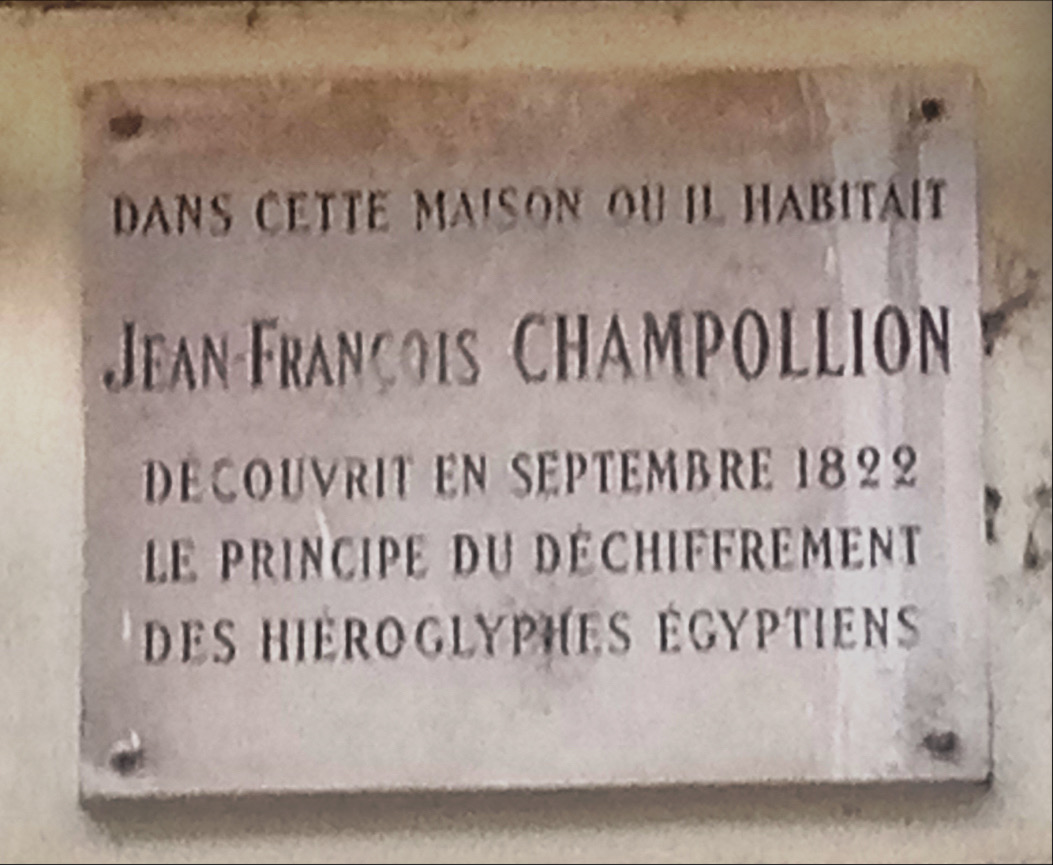
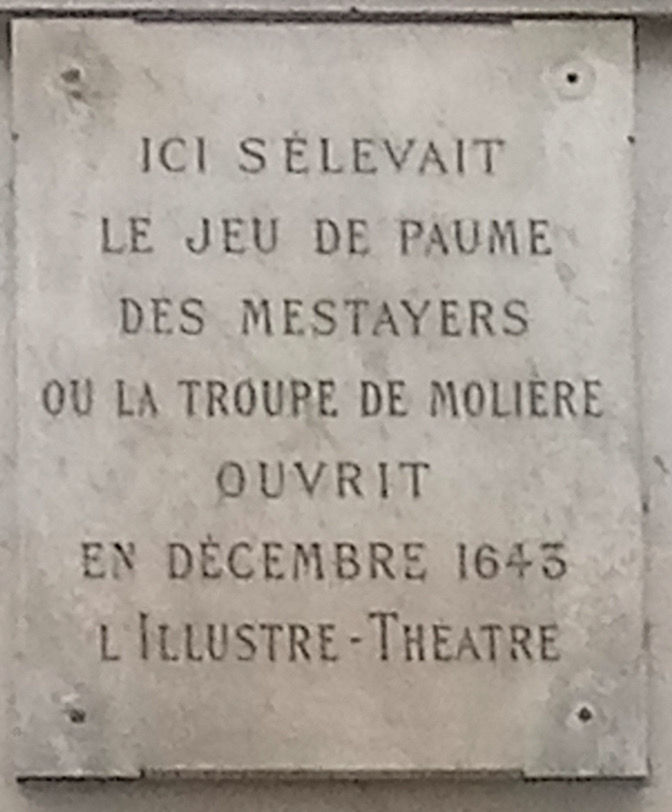
One of the many pleasures of walking in Paris is stumbling upon obscure historical plaques on the sides of otherwise nondescript buildings. In Rue Mazarine, which is near the Seine and virtually in the centre of the city, I came across three within a hundred metres of each other that got my geek-tourist juices flowing:


Theatrical types might hone in on Moliere, but it was the reference to Champollion that got me a bit excited. He was the first to decipher Egyptian hieroglyphics and unravel the “mystery” of the Rosetta Stone. There are a bunch of documentaries about him, including this little piece narrated by Carl Sagan:


This is an bloody amazing city to wander around.

Jardin des Plantes


I’d planned a visit to Musée d’Orsay today, but it seems lots of places are closed on Mondays, most museums included. So I took a 10 minute walk to the Jardin des Plantes.

The Paris Botanical Gardens date back nearly 400 years and cover 19 hectares of various styles of garden. There are long stretches of neat garden beds interspersed with the buildings of the Museum of Natural History. There is a zoo, which I avoided. There are some lovely less frequented areas for specimens of particular climate types.

I spent several hours in the Alpine Garden. It’s a surprisingly lush, happily wild enough affair that would make the heart of my friend Marie-Louise sing.

Can the term “exquisite” apply to a vast garden? I guess it depends on the point of observation and the scale of observance. These are crafted gardens, but nothing like the ordered regiments of Palais Royal or the Tuileries. This garden is tended (by many, it seems) but not at all restrained by borders and edges. Plants mingle and climb each other, and tumble down walls and across paths. It was busy today, but not crowded, with bird song and rustling leaves rising above the rumble of traffic.

The numbers of gardeners at work surprised me. Surely the sign of a civilised society when public gardens have such resources applied.

Gallery

Liberté, égalité, fraternité

Came across this modest elementary school on my walk around the neighbourhood today.


A modest school indeed, but a bunch of dried flowers beneath a plaque caught my eye.


I could read it well enough, but I’ve resorted to Google translate for more comprehensible prose:

IN THE MEMORY OF CHILDREN, STUDENTS OF THIS SCHOOL, DEPRIVED FROM 1942 TO 1944 BECAUSE THEY WERE BORN, THE INNOCENT VICTIMS OF BARBARIA NAZIE WITH THE ACTIVE COMPLICITY OF THE GOVERNMENT OF VICHY, THEY WERE EXTERMINATED IN THE CAMPS OF DEATH.  
 NEVER FORGET THEM 
January 11, 2003

Basilique du Sacré-Cœur

After my visit to Musée de Montmartre, my heart rate was low enough to make an attempt on the summit, which is crowned by Basilique du Sacré-Cœur, a not particularly splendid church built in the 19th Century. It was, apparently, against the wishes of many of the more radical locals, who thought it against the spirit of the place. 

As it turns out, I’m with the radical locals. It’s noted for its panoramic (fuck it, when is a view from the top of a hill not panoramic?) view of Paris. Now, I can’t actually attest to the quality of the view, as it was teeming with tour groups all madly snapping photos over the heads of other tour groups. I’m pretty sure most photos turned out like mine:


The car park at the front of the Basilique du Sacré-Cœur features in many of Claude Lelouche’s films. Claude is my all-time favourite film director, and he used the location in his 1976 nouveau-bogan classic, C'était un rendez-vous. The film is a mere 8 minutes of a single shot from the front of a car being driven at break-neck speed through Paris. To be honest, it’s probably not Claude’s finest film, but why take my word for it? Make your own mind up. Here, Mesdames et Messieurs, is the full, unexpurgated C'état un rendez-vous.


Frankly, Lucy Jordan, you did yourself a favour not driving through Paris in a sports car with the warm wind in your hair.