The Prado

Velázquez: The Surrender at Breda 1635

I came to Madrid because I saw a Goya portrait in the Louvre, and wanted to see more. The Prado had dozens (probably hundreds) of Goya’s. And Velázquez. And Rubens, Van Dyck, Titian, Bosch, Brueghel (Jan, Pieter, older, younger.) Not to mention Rembrandt (some of which I saw at the Rijksmuseum in Amsterdam where they are on loan.) 

If you’re wondering why so much from the Low Countries, remember that Spain ruled a goodly part of the Netherlands for 150 years. They must have developed a taste.

They’re the big names. There are many others that don’t make it into the coffee table books, especially when it comes to the religious and historic stuff which the Spanish seem to have been particularly keen on. Not surprising, really. It’s still a very religious country, and they delight in dressing up in military costume old and new. There were chaps in doublet and hose with capes all over the place this evening when I walked around the squares. They might have been masons or something.


I spent the day in the Prado. It’s not exactly a delicate construction. The architecture is pretty muscular. More like a British bank than the home of the nation’s culture. Still, it’s what’s inside that counts.

I started with a stroll past a vast sweep of Gothic and Renaissance works, mostly on a grand scale. There’s a Caravaggio - one of his versions of David with the Head of Goliath. It’s in a room surrounded by works by Spanish artists who were (according to the written commentary) greatly influenced by the Italian. It’s not hard to see as much in the paintings. Lots of brutal imagery, with muscles upon muscles and variously severed limbs.


Caravaggio: David With the Head of Goliath 1600

I worked my way along to room after room of Velázquez doing his thing (never as nicely as Rembrandt, I think) and then some striking still life's, especially focussed on floral arrangements (very Spanish, apparently.) Eventually I hit the first of the Goya collection - his court paintings and images of rural life. Good, but not so good as to stand out from his peers. Rubens was next. I never expected to see so many. Apparently some of the Philips were big on his work, and could afford to pay his very high rates. I get that Ruben was a very good operator, but you get a bit sick of so many big bottoms and wrinkly bits.

Just like the Louvre, the Prado isn’t very easy to navigate. They seem to organise by period and style, but there are a lot of stairs in the way. I found the next Goya’s two floors up. A huge collection of cartoons he did for tapestries. He simplified his palette, and kept the subject matter suitable for (grand) home decor. It’s interesting to see, but I wanted something a bit more eyeball grabbing. There were some Flemish painters at the other end of that floor (down stairs then upstairs) and some interesting court treasures from France.

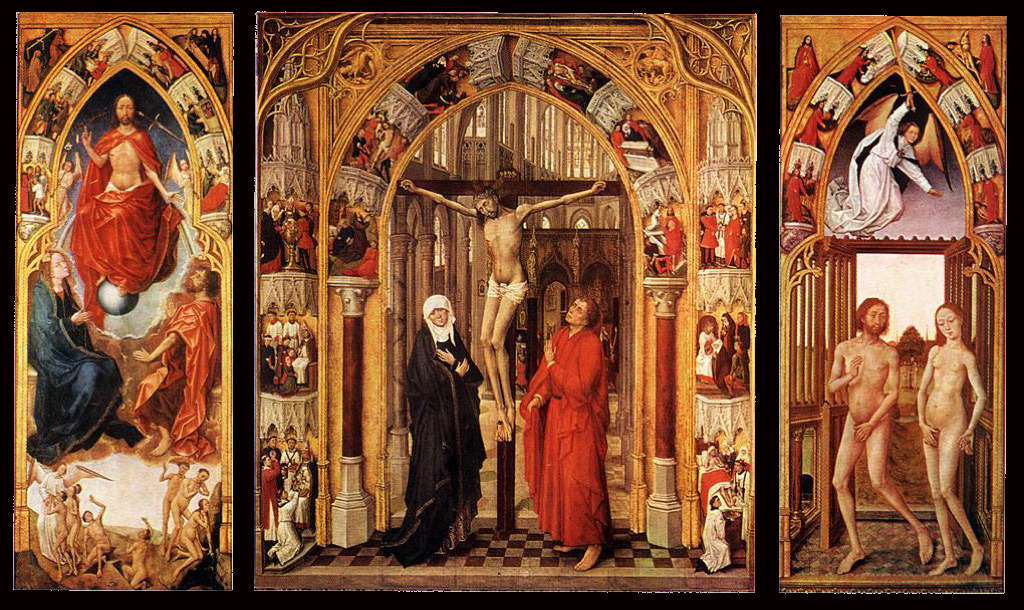
After a much needed espresso, I headed for the basement. Where else would you put Goya’s black paintings? I got waylaid by some fabulous alter pieces and triptychs. They went from medieval to Gothic to early Renaissance, with ever more detailed descriptions of heaven and hell. I could almost smell Bosch’s Garden of Earthly Delights around the corner. I was right. I’d always thought Bosch was a complete outlier, but he is contextualised in the Prado. This piece is like a trailer for the Bosch movie:

Vrancke van der Stockt: Redemption Triptych c. 1459

There were other gems, including some Brueghel (I forget which one) and Rubens double acts worth the price of admission, and some images from a 1615 parade in Brussels that would put Where’s Wally in his place.

Denis van Alsloot: The Festival of the Ommegang in Brussels: the procession of Our Lady of Sablon 1615

Finally, Goya’s black paintings. His descent into depression or madness, never intended to be shown. There are one or two which are best left alone, but the majority of the twenty or so canvases are surprisingly captivating. There’s a deep compassion here, and the technique is of an old man who has no need for gimmicks. There’s a lot in common with Rembrandt’s last few years, and Turner too. Every brush stroke seems applied at a distance. There’s no detail, just the sum of an artist’s skills projected onto the canvas. This is as good as art gets - says me.


Goya: The Dog c: 1823

A portrait found me on the way out. Painted by a Spanish artist in Paris. Not hard to see the obvious influences. Beautiful.
Raimundo de Madrazo: La modelo Aline Masson c. 1876
Gallery


If you want more detail on the pictures, you can see the Google Photos gallery here.

All images public domain

Puerta del Sol


Tapas. Lottery sellers. A woman offering me her services. Street artists being statues. Madonnas and child. Priests’ robes for sale (tempting). Paella. San Miguel. Ribbon. Lace. Baubles (35 days to Christmas). Real Casa de Correos. Football shirts. Real! Athletico! Tio Pepe. kilómetro cero. The bear and the Madrono Tree. Pork and more pork. Hola. Café con leche. Laughing children. Muchos gracias. Speedy Gonzales.

Gallery

Madrid

I’m in Madrid. I arrived this afternoon. Shortly after leaving the airport, I realised I knew absolutely nothing about this city.


Apparently everyone speaks Spanish here.

Rembrandt and Velázquez

The Rijksmuseum has an exhibition of Dutch and Spanish masters. It’s a sort of exercise in comparison. Sometimes it works, especially when the subject matter is related, and sometimes there’s a tenuous similarity in composition and the viewer is expected to make appreciative “Mmmm” noises. Still, who cares? A chance to see a whole bunch of masterpieces by dead white guys.

Wait...

I can tell you this. Rembrandt stands alone. Anybody who can paint themselves wearing this costume without drawing a round of “What does he think he is?” from the audience has to be good:

The Standard Bearer 1636 (self-portrait)
And Rembrandt is very good. He’s 250 years better than any of his contemporaries good. He’s the best “I’ll use this brush any way I choose to” artist before Turner good.

Revisiting Vincent

The first gallery I visited on my brief visit to Amsterdam three weeks ago was the Van Gogh Museum. I haven’t written about it, because I wasn’t sure I trusted my own responses.

My expectation was to be disappointed. Let’s face it, Vincent is the Elvis of art. There are probably more kitchen aprons with his Sunflowers on them than there are sunflowers in the south of France. There are enough movies about him to occupy a month of binge watching. Every household in the Western world has an object decorated with Irises. Monet might run a close second in the home decor stakes, but he made the mistake of living to a ripe old age and keeping most body parts attached. It’s a statistical fact* that no artist has more fables attached than Vincent Van Gogh. His popularity just has to be an accident of history.
* Prove me wrong.

Problem is, I loved the Van Gogh’s first time around. Despite the crowds, despite the groupies surrounding Sunflowers, despite the fact that I’d seen a lot of the pictures in an episode of Doctor bloody Who... I loved every last image. And I figured that might have been because it was the first gallery I visited on this art lover’s odysseyette through a few Western European cities. My critical faculties may have been overwhelmed.

Landscape at Twilight 1890
It’s my last day in Amsterdam. I’m off to Madrid in the morning, so I decided to revisit the Van Gogh Museum and the Rijksmuseum.

Van Gogh got the same response second time around. I can’t really explain why.

Even when he does something badly, he does it badly in a way nobody else does. Here’s his portrait of Agostina Segatori (1887-8): 


Check her left hand with the cigarette. All wrong. Kwinana Senior High School schoolboy wrong. Does the portrait still reach into a man’s chest and rip his heart in two? Absolutely.

I may have to start listening to Elvis Presley.

My dutiful laundrette

The lovely Autumn weather gave way to a cold, wet, windy day. I ventured as far as the neighbourhood laundrette to do my domestic duties. I had the place almost to myself.


I quite look forward to domestic challenges. Not having been in a laundrette for 25 years, I was wondering how I’d fare with making things work. I expected Google Translate to get a workout, but thankfully, a set of English instructions was on the wall. The days of coins in slots are gone - it’s a central console where you add credit to control various machines and dispensers.

The view through the shopfront was nondescript enough, but when I glanced out a side window, I could only have been in Amsterdam:


The call of the running tide

What makes Amsterdam so special is that its proximity to water manifests in surprising ways. You turn a corner, or walk up stairs, and there is so often an unexpected view. And this being The Netherlands, I assume most of it is constructed. Which came first? The city or its artists?

This is my view when catching the bus home from Amsterdam Centraal:


And this is what I see from out front of my apartment:


Perhaps they pay someone to check the sight lines.

It’s an abomination, I tell you!”

I’m staying in a “serviced apartment.” Well, apartmentette. It’s nice to make my own breakfast before facing the challenges of navigating Amsterdam.

I found this in a supermarket. It’s really not the same.


I wonder if the pigeons would eat it.

Not all treasure’s silver and gold...

It was a corker of a day in Amsterdam. Here’s Amsterdam Centraal replete with:
  • Blue sky
  • Tram 
  • Herd of bicycles
  • Token pedestrians.

Note the absence of cars. I came into the centre early to send a parcel of clothes home. I packed too much, and too heavy...

As a salve to the obligatory self-pity over my damaged ear, I spent the afternoon at the Scheepvaartmuseum - the Netherlands Maritime Museum - which is about 200 metres from my apartment in the Amsterdam docklands. It occupies a 17th Century naval store plonked in the middle of a small inlet of Amsterdam Harbour, and it’s full of paintings, model ships, relics and cannon. My idea of a good time.

Most wonderful of all was the full-scale replica of The Amsterdam, an 18th Century VOC East Indiaman. Although the original was 120 years younger, it’s much the same size and tonnage as The Batavia. (There’s a replica of The Batavia, but it’s at a theme park outside Amsterdam.) The Amsterdam replica was built in 1995 from African Teak, as massive oak trees are hard to come by these days. Ironically, African Teak is now a threatened species. 

These ships were the Starship Enterprises of their day. A round trip to Batavia could take two years, and, as we know, many of them forgot to take a left turn at Albuquerque. The Amsterdam is nearly 50 metres long with masts a metre wide at the base, but I’d still back the reefs of the Abrolhos when push comes to shove. 

It wasn’t crowded, and there were few restrictions on exploring the vessel. I refrained from making for the crow’s nest, but I did, of course, resort to speaking like a pirate for some hours after my visit.


Normal service will be resumed

I’ve entered into some weird cross-dimensional symbiosis with Vincent Van Gogh. Last night I fell out of bed and my ear caught on the corner of the bedside table. The top part of cartlidge was torn. There was a lot of blood. Same ear as Vincent too.

It’s mostly stopped bleeding now, but I was freaking people out on the bus today. Blood coming from one ear...

I’m feeling like I need to paint sunflowers.

Image public domain Wikimedia

To Amsterdam - Part the Second

Just before a tunnel that leads into Rotterdam, the high speed Thalys train became a no speed train.

The announcements got progressively worse. “Ladies and Gentlemen, we have a red signal, and we’re just waiting for it to change. We’ll be at Rotterdam Centraal very soon.”

“Ladies and Gentlemen, we have a red signal and we don’t know why. We’ll let you know when we know more.”

”Ladies and Gentlemen, there is a problem in the tunnel ahead, and we’re awaiting more information.”

“Ladies and Gentlemen, there is water in the tunnel. The Thalys train will not proceed until it is safe. This may take some hours. Those passengers intending to get off at Rotterdam Centraal should exit the train and walk to the Metro station.”

“Ladies and Gentlemen, we don’t know when we will proceed. Passengers wishing to get to Rotterdam or Amsterdam may wish to get off the train and walk to the Metro station. Take the Metro to Rotterdam Centraal, then seek instructions on how to get to Amsterdam.”

The by now quite drunk Canadian couple across the aisle were decisive. They chose to stay on the train and drink it out.

I too was decisive. I had a 6pm check-in deadline in Amsterdam. I was going for the Metro option. The Metro in The Netherlands, by the way, usually means trams. The place is two centimetres above sea level, so underground subways are mostly out of the question.

The Thalys conductor was also decisive. He was outside the train having a cigarette. I asked him how exactly one got to the Metro. He pointed towards a gaggle of suitcase-wielding decisive people in the distance. “Follow them,” he said between smoke-rings.

I stumbled down the embankment at the side of the train towards a pedestrian bridge. By the time I’d got to the steps, there was nobody in sight. Should I go back to the train? Not this cookie who used to be a Boy Scout. I had a plan.

I’m sure you’re thinking I climbed a tree or lit a campfire. Actually, I downloaded the Google map for Rotterdam, and used the CityMapper app to guide me through eerily quiet housing estates to the tram stop. There were a few people there from the train who seemed to know what they were doing, so I decisively (but discreetly) followed them.

Seven stops later, I strode dragged my suitcase into Rotterdam Centraal. I spotted the last remaining passenger from the train at the end of an escalator, but then I lost them. I was on my own again. After some time frantically crisscrossing the vast station, I found the ticketing office. I knew they’d want to help a stranded passenger. I went straight for the counter.

I was told to take a number and wait.

I took a number, but it was for the wrong type of train. Finally, some twenty minutes later, I explained my situation to a mildly helpful chap at the Thalys counter. I was to go to Platform 11. I could use my Thalys ticket there to get to Amsterdam.

Platform 11 was mostly deserted, so I walked down the platform to get a long overdue coffee. When I walked back, there was a small crowd of vaguely familiar individuals with suitcases. Within minutes, the familiar red of a Thalys train appeared and eased to a stop. After a small weep, I kissed the nearest conductor. It was two hours since I’d made my own personal version of Von Ryan’s Express, but I’d made it. This was epic stuff. I could sell the film rights. I chose the same carriage number as was on my original ticket, and crawled down the aisle, pushing my suitcase before me.

Two very drunken Canadians greeted me. “Hey, Aussie, you’re back...”

Image:© urbanrail.net but I don’t care, because they owe me. I’m using their map.

To Amsterdam - Part the First

My first (of many, I’m sure) change of plans. Rather than head south from Paris, I’m heading back to Amsterdam for a week or so. I had three days there before Paris and loved it. I think there may be much more to discover. After Amsterdam, I’m not sure. Berlin, perhaps.

I’m writing this on the Thalys, a high speed train that travels between Paris and the Low Countries. It takes about three hours to get to Amsterdam Centraal, and it’s a smooth, comfortable ride. We’re going to do a quick invasion of Belgium along the way.

I’m sitting next to a French-speaking woman who seems quite miffed that anyone would have the impertinence to book the seat next to her. She makes an entirely theatrical show of moving the arsenal of baggery off my seat. After a long, loud phone conversation (which is how I know she’s a French speaker) she pulls out her e-smoker thingy and proceeds to take long, deep gurgling draws that sound something akin to the guttural racket a cat makes just before it lets loose with last night’s Whiskas behind the couch.

Minutes later
Vapowoman has now decided that the first 150mm of my seat adjacent to hers is, in fact, her seat. She’s placed a stiff, rustly plastic bag up against my leg. I, of course, am a paragon of cool, and choose to ignore it. I’m wondering if I should casually put my hand into the bag and crush the contents.

More minutes later
We’re passing through some fine French countryside and I’m looking past her laptop and out the window. She is furiously typing emails (some people provide emphasis to what they write by hitting the keys harder) and mistakes my gaze to mean I’m reading her emails. Now, truth be told, if they were in English, I probably would read them, purely for my own edification. Unfortunately, she’s writing in French. I would like to get her email address though, so I can send her links to websites that show rotting lungs caused by vaping. Nothing like the sanctimony of an ex-smoker. Meanwhile she methodically angles her laptop screen away from me.

It’s one of the shortcomings of not having local language fluency - I can’t make acerbic, coded comments on her actions, so I’m left to just sigh loudly. Hey, she wants to be melodramatic? Two can play at that game. Sadly, she’s too busy munching on a too-healthy-to-be-tasty salad in between cat-fart gurgles to notice my superb pantomime.

It’s the wide windows that make high speed trains so much better than planes. We’re going 300 kilometres per hour through wind farms and past villages, and there’s a bit of sunshine to dapple the view. There’s a Canadian couple across the aisle doing their damnedest to get as drunk as possible as soon as possible, and having a non-stop conversation in which they say absolutely nothing interesting but manage to paint a very clear picture of the dynamics of a couple who have been trying to get one up on each other since the honeymoon. I’m jealous of them though. Being Canadian, I assume they can determine if the French couple behind them are saying anything interesting. Except they may be too drunk already.

A little later
We’re nearing the Belgian border now. We’re in the Arras end of France.

A few minutes after a little later
Vapowoman is giving herself a complete makeover. The full contents of her makeup case are now spilling across the cabin. It makes me think she might be getting off the train in Brussels, although not before letting the cat loose behind the couch again.

We’re not far from Brussels. This means, of course, given it’s Tuesday, we must be in Belgium.

A simultaneous makeup job and vape later
She stands to get off in Brussels with a polite, ”Excusez-moi.” I simulate a French accent, wishing her, “Bon voyage.” 

“Merci.” She smiles warmly and strides off down the aisle, bags trailing behind her. 

I brush the crumbs off her seat.